UV reactive clothing glows because it contains fluorescent molecules that absorb ultraviolet light and re-emit it as...
Latest posts
-
 UV Reactive Clothing: What Actually Glows Under a Blacklight and WhyRead more
 -
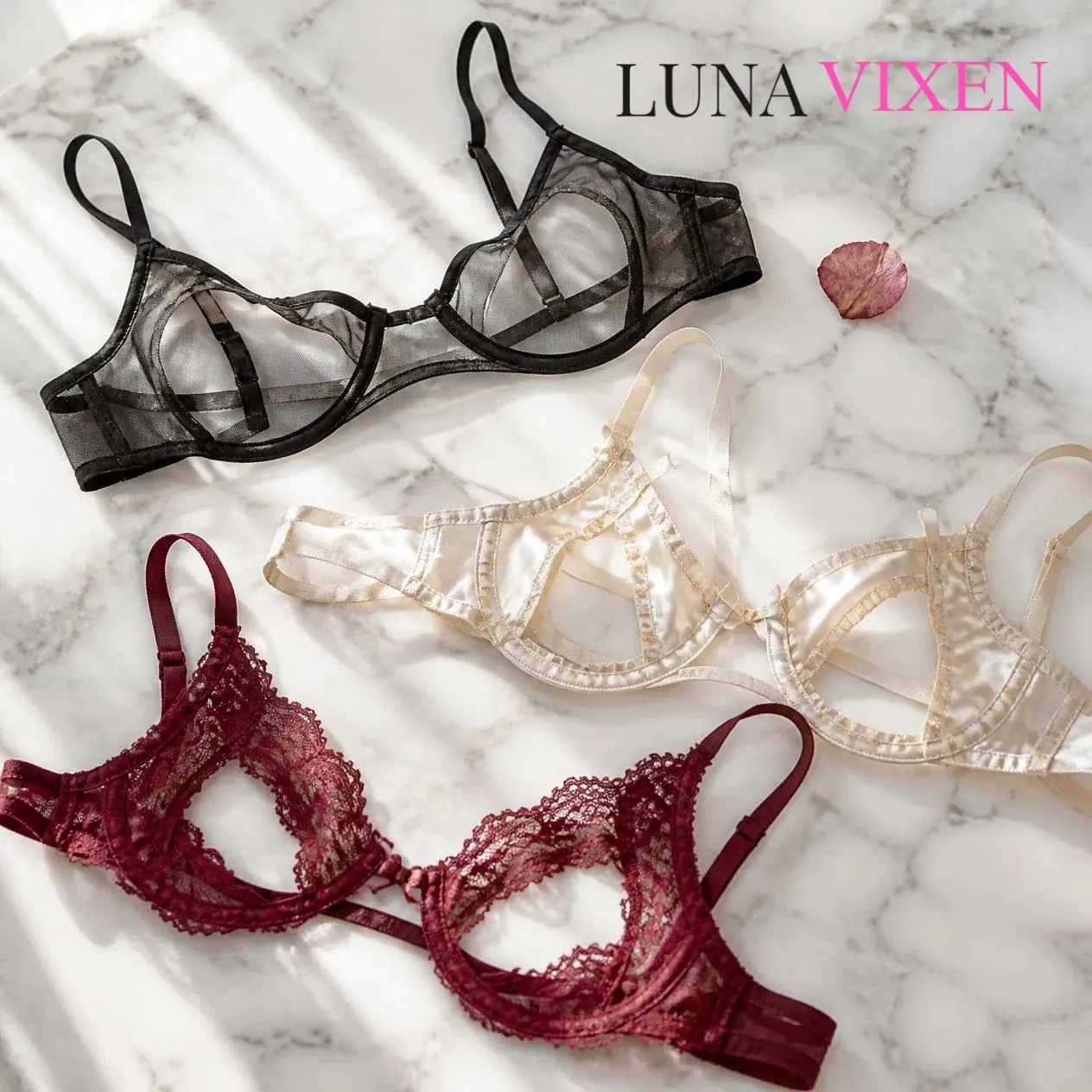 Open Cup, Peek-a-Boo and Cupless Bras: What They Are and How They FitRead more
Open cup, cupless, peek-a-boo, shelf, quarter cup: the names get used interchangeably almost everywhere, and they are...
-
 Lingerie for Every Anniversary: What to Wear and Why It WorksRead more
The right lingerie for a specific occasion is less about the garment and more about knowing what that moment actually...
-
 Plus Size Lingerie Fit Guide: Sizing, Fabric and What Actually WorksRead more
Plus size lingerie fit is its own skill set, and the biggest obstacle is usually language: sizes labeled Queen, 1X,...
-
 Lingerie for Every Body Type: What Works and WhyRead more
The cuts that feel right on your body are not random. Lingerie works or doesn't work based on how its structure...
-
 How to Buy Lingerie for the First Time (Without the Guesswork)Read more
Buying lingerie for the first time feels harder than it should be, mostly because no one explains the basics and...
-
 Types of Lingerie Fabric: What Sheer, Mesh and Lace Actually DoRead more
The words on a lingerie label are doing real work. Mesh, lace, powernet and satin each behave differently on the...
-
 How to Wash Lingerie Without Ruining It: A Guide by FabricRead more
Different fabrics fail for different reasons. Lace snags, satin watermarks, vinyl cracks, UV reactive dye fades under...
-
 Thigh High Stockings: Denier, Seams and How to Keep Them UpRead more
Thigh high stockings stay up when three things align: the right denier for the occasion, a band that fits your thigh...
-
 Corset vs Bustier vs Basque vs Waist Cincher: Which One Do You Actually Need?Read more
Corset, bustier, basque, waist cincher: the names get used interchangeably online and almost never mean the same...
Blog categories
Search in blog
Archived posts

How did lingerie actually start, and what did it have to do with sex?
Sexy lingerie has never been one thing. It has been armor, rebellion, theater, and sometimes just a very good Tuesday. The history of what people wear closest to their skin tracks almost perfectly with how women have understood their own bodies and their right to dress them on their own terms.
How did lingerie actually start, and what did it have to do with sex?
Mostly nothing, at first. The earliest undergarments were about function: keeping outer clothes clean, managing body temperature, and giving corsets and petticoats something to grip. Sex was rarely the point. The erotic charge we now associate with lingerie is largely a twentieth-century invention.
For most of Western history, a woman's underclothes were heavy, layered, and completely hidden. The shift, the chemise, the drawers, the corset cover, none of these were designed to be seen. They were seen by a husband, eventually, but that was almost incidental.
The turn happened slowly, then fast. Nylon arrived in the late 1930s and changed everything about how a garment could feel against skin. Suddenly fabric could be light, close, sheer. The silhouette underneath started to matter in a different way.
By the postwar decades, department store lingerie departments were selling something that sat between utility and desire, though the advertising still leaned heavily on words like support and foundation. The erotic language came later, and largely through fashion photography and film.
What changed most was who the clothes were for. A chemise in 1880 existed to protect a dress. A slip in 1955 existed to smooth a skirt. A bralette today exists because the person wearing it chose it, which is a genuinely different relationship to the garment than anything that came before.
The history is worth knowing because it explains why so much lingerie marketing still feels slightly uneasy, caught between the old language of function and a newer, more honest acknowledgment that desire is a legitimate reason to buy a beautiful thing.
What changed in the corset era that still shapes lingerie today?
The corset era gave us the idea that underwear could be architecture. Before the 19th century, foundation garments were mostly about coverage. What shifted was the expectation that lingerie should shape, structure and relate deliberately to the body beneath the clothing. That design logic never left.
Boning is the obvious inheritance. Steel and whalebone gave way to spiral wire, then to flexible plastic stays, but the principle of vertical structure running through a garment is still visible in every underwired bra and every structured bustier produced today.
Less obvious is what the corset era did to lace. Manufacturers began producing machine-made lace at scale in the mid-1800s, which meant decorative trim stopped being a luxury reserved for the very wealthy. Lace became a design language for intimate wear specifically, and it never migrated back out. The floral embroidered mesh sets made today are a direct descendant of that shift.
The garter belt is another corset-era artifact still in active use. It originated as a functional tab at the base of a corset, holding stocking tops in place. The corset itself disappeared from daily wear after World War One, but the garter attachment stayed, separated into its own garment.
What the era also baked into lingerie culture was the matching set. Corsets were routinely made with coordinating pieces, a chemise or drawers in the same fabric. The contemporary matching lingerie set as a category owes that expectation to Victorian dressmaking conventions more than to any modern trend.
How did the 20th century turn intimate apparel into a cultural battleground?
Every decade pulled lingerie in a different direction politically. The corset became a symbol of women's oppression, then its abandonment became liberation, then reclaiming structured underpinnings became radical again. What you wore under your clothes stopped being private the moment society decided it carried meaning.
The 1920s flattened the silhouette. The 1950s rebuilt it into an hourglass enforced by bullet bras and cinchers. By 1968, women were reportedly tossing bras into protest bins outside the Miss America pageant in Atlantic City. The garments themselves hadn't changed much. The argument around them had exploded.
Punk and fetish aesthetics crossed into mainstream retail during the 1980s, pulling vinyl and leather lingerie out of specialty shops and into conversation. Madonna wore a cone bra on stage. Suddenly the underwear-as-outerwear question wasn't shocking, it was fashion editorial.
The 1990s brought the supermodel era, which made lingerie advertising into genuine cultural events while also narrowing the visible definition of who lingerie was for. That narrowing had consequences that took decades to fully reverse.
What the century proved is that fabric and fit were never really the point. Lingerie kept absorbing bigger arguments about autonomy, gender, class, and desire because it sits right at the boundary between private and public self. It's intimate by definition and contested by history.
What does sexy lingerie mean now compared to fifty years ago?
Fifty years ago, sexy lingerie meant one specific silhouette: structured, push-up, designed almost entirely around a male gaze that had been doing the deciding for decades. Now it means whatever actually works for the person wearing it. That shift is not subtle, and it changed what gets designed, what gets bought and what gets kept.
In the 1970s, the dominant language was control. Underwire, padding, waist cinching. Garments built to reshape the body rather than fit it. The fantasy was external, something performed for someone else in a very narrow script.
What changed is not that people stopped wanting to look good. They started caring more about how something feels on than how it photographs in theory. Softness, stretch, skin-accurate sizing, cuts that account for actual bodies rather than a single standardized form. plus size lingerie stopped being a reluctant afterthought and became part of the main conversation.
The materials changed too. Satin charmeuse, mesh, stretch lace, and categories like vinyl and leather lingerie moved from niche to visible. So did the acknowledgment that men wear lingerie, that couples buy it together, that solo wear is reason enough.
Sexy got broader because the definition stopped being handed down from one direction. A barely-there bodysuit is sexy. So is a full-coverage bralette that fits perfectly. The common thread now is intention, wearing something because you chose it, not because a magazine told you it was the correct answer.
Has the definition of sexy in lingerie always been set by the same people?
Mostly, yes. For decades, the visual language of lingerie was built by a narrow group of designers, executives and photographers who decided what bodies looked good in lace and who got to wear it in public. That definition stuck, and a lot of people spent years shopping around it rather than through it.
The shift happened slowly, then all at once. Brands started sizing up, not as a footnote but as a full commitment. Bodies that had always existed started appearing in campaigns, on fit guides, on product pages. The vocabulary of what reads as sexy on a garment stopped being a single silhouette.
Practically, that means a lot more variety in what actually gets made. Cut-out details on fuller busts. Adjustable straps engineered to do real work. plus size lingerie that uses the same fabrics and finishes as the rest of the range, not a scaled-up afterthought in a different colorway.
There's also been a quieter shift in occasion. Lingerie stopped being purely aspirational or purely functional and became something people wear for themselves on a Tuesday. That changed the design brief. Pieces needed to feel good in natural light, in real rooms, on real bodies that don't hold a pose.
The definition hasn't been fully rewritten yet. But it's genuinely wider than it was, and the people setting it now include a lot more of the people actually wearing it.
Common questions
Why did bras replace corsets instead of some other garment?
Corsets controlled the whole torso, so whatever replaced them had to address at least the chest, which was doing real structural work. The bra arrived at the right moment: early 20th century dress silhouettes moved away from the hourglass and toward a straighter, more mobile line, and women needed something that could work with that without compressing the ribs. A soft chest support fit the new shape. Camisoles existed but offered no separation or lift. Girdles took the waist job. The bra didn't win by being better than everything, it just matched the specific problem that was left uncovered.
Is vintage lingerie style coming back or just being referenced?
Referenced, mostly, and that distinction matters. What you see now are specific vintage signals, bullet bra geometry, wide satin straps, longline silhouettes, tap short lengths, dropped into modern construction. The fabrics are softer, the sizing is more forgiving, the underwires if there are any sit differently. Designers are borrowing the aesthetic vocabulary of the 1940s and 1950s without the discomfort or the limited fit range. A true revival would mean structured cotton and metal boning. What's actually happening is more interesting: the shapes get kept, the context gets updated.
What fabrics have stayed consistent across lingerie history?
Silk and cotton have never really left. Silk because it regulates temperature, moves with the body and has a weight that synthetic fabrics still don't quite replicate. Cotton because it breathes, washes reliably and sits comfortably against skin for long wear. Lace, technically a construction technique rather than a single fabric, has also persisted across centuries in various forms, from needle lace to modern stretch Leavers lace. What changed is who could access them and how they were combined. Nylon arrived in the 1940s and shifted the economics entirely, but silk and cotton kept their place in the quality tier.
Did men's underwear go through the same kind of cultural shifts?
Yes, though the timeline runs a little behind and the cultural pressure was different. Loose drawers gave way to union suits, which gave way to separate tops and bottoms in the early 20th century. The brief arrived in 1935 and caused genuine public controversy about modesty. Boxers emerged from sportswear. The 1980s and 1990s brought the same kind of brand-driven image shift that women's lingerie had seen decades earlier, with Calvin Klein using billboard-scale advertising to make men's underwear aspirational rather than purely functional. The conversation around fit, fabric and aesthetics for men's undergarments is still catching up.
Posted in:
Default category